Practice Repetition Is a Question, Not a Score
Practice repetition can reveal which part of a skill is reliable. Vary one task element at a time and use the result to choose your next cue.
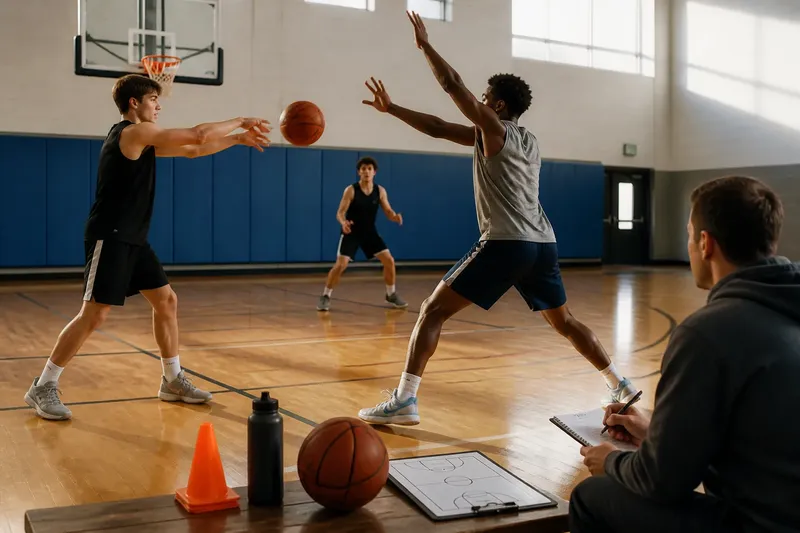
A basketball player makes a clean chest pass across the gym, then sends the next one too high when a defender steps into the lane. The first pass counts as a repetition; the second gives the player a question to investigate. Practice repetition is more useful when each attempt helps you notice what holds steady and what changes.
A large count can tell you how much work you did. It cannot, by itself, tell you whether a skill will survive a new angle, pace, target, or decision. Treat a drill as a small, controlled inquiry: keep most of the task familiar, change one element, and pay attention to the result. That makes practice more informative without turning every session into a complicated experiment.
What can practice repetition tell you?
Each repetition gives you a chance to observe a particular part of a skill. A soccer player might watch the first touch after a pass arrives, while a swimmer might attend to the timing of the breath. Choose one observable detail rather than judging the whole performance as simply good or bad.
Before a set, name what you want to notice. For a tennis serve, that might be whether the toss stays in a useful place when you aim toward a different section of the service box. The question is not whether every serve looks identical. It is whether the chosen part remains manageable under the condition you have introduced.
Record a brief note between sets if that helps. “Contact stayed centered when I aimed wide” says more about the task than “felt good.” A note should capture what happened, not turn a single attempt into a verdict about your ability.
Why change only one element at a time?
Changing one element makes it easier to interpret what you notice. If you move the target, speed up the drill, and add a defender all at once, a missed attempt does not tell you which change mattered. Keep the rest of the task familiar long enough to make a useful comparison.
Possible elements to vary include:
- Target: Send a pass to a nearer or wider target while keeping the delivery method consistent.
- Starting position: Begin the movement from a different spot, without changing the intended action.
- Approach angle: Receive a ball or enter a movement from a new direction.
- Tempo: Adjust the pace while keeping the same target and basic setup.
- Choice: Ask for one of two actions, while keeping the physical demand similar.
- External cue: Respond to a call or signal rather than beginning on a predictable count.
Do not add every variation just because it is available. Select one that relates to a situation you want to handle, and keep the rest of the drill stable.
How do you choose what to vary?
Start with the part of the skill that seems dependable in the current setup. Then identify a nearby condition that would matter in play. If a volleyball player controls a standing pass from a partner, the next useful change might be the direction of the feed, not a jump, a new ball, and a scoring rule all at once.
Make the variation small enough that you can still attend to the skill. A dramatic change may make the task so unfamiliar that you are no longer examining the same action. If you cannot tell what happened, simplify the setup and return to one clear cue.
Say a baseball player is working on throwing to a teammate at a fixed distance. The player wants to know whether the release stays consistent when the teammate shifts to one side. They keep the same ball, partner, and throwing pace, then move the target a little wider. If throws continue to reach the target with a similar release, that is a useful observation; if they drift, the player can return to the original spot and focus on the release cue. Neither result is a score for the athlete. Each suggests what to practice next.
How many repetitions should you do before changing the task?
Use enough attempts to notice a pattern, but do not choose a count as proof that learning has occurred. The right amount depends on the skill, the athlete’s attention, and the practice setting. A short set may be enough to spot a clear change; a longer set may be useful when outcomes naturally vary.
Look for a repeated, observable tendency rather than demanding identical results. For example, does the same part of the movement become difficult whenever the target shifts? Can the athlete describe what changed? A run of successful attempts is encouraging, but it does not settle how the skill will work in a different setting.
Pause when the cue gets blurry. If fatigue, distraction, or rushed attempts make it hard to attend to the chosen detail, continuing to count may add little information. Take a brief reset, reduce the difficulty, or end that task and revisit it later. The purpose is to learn from the work, not to reach an impressive number.
What should you do when the result changes?
First, describe the change without adding blame. “The pass went behind the receiver when the angle widened” is more useful than “I always lose control.” Then decide whether the variation was too large, the cue was unclear, or the skill needs more practice in the familiar setup.
If the action broke down, restore one condition at a time. Return the target to its usual spot and repeat the task while attending to the chosen detail. If that looks steadier, reintroduce the variation in a smaller way. If it still feels difficult, ask a coach to observe the movement; a coach may notice a feature that is hard to track while performing.
If the movement stayed reliable, do not immediately make every part harder. Keep the useful change and test another relevant condition in a later set or session. Reliability means the skill held up under the condition you tried. It does not mean every possible version of the task is solved.
How can you tell whether a skill is becoming reliable?
Reliability is a pattern across conditions, not a streak in one familiar drill. Notice whether the same important part of the action remains workable when one demand changes. Also notice whether you can return to a familiar cue after an unsuccessful attempt, rather than making several unplanned adjustments.
Useful signs can include:
- The chosen movement detail remains recognizable when the target or starting point changes.
- A missed attempt has a clear cause you can describe, rather than several possible causes tangled together.
- You can repeat the task after a short pause without needing to rebuild the entire routine.
- You can adjust to a new cue while keeping the basic skill intact.
- Your coach or practice partner can see the same change you are tracking.
These signs help guide the next practice choice; they are not a pass-or-fail test. A skill can look steady in one setting and still need attention elsewhere. Keep the next variation connected to the demands the athlete is likely to face.
Should every practice set include variation?
No. Repeating a stable setup can help an athlete learn the movement and focus on a specific cue, especially when the skill is new or the task is demanding. Variation becomes useful when it asks a clear question, not when it is added for novelty.
Alternate between familiar work and a modest change when that suits the session. A runner learning a new stride cue might first use a consistent, easy stretch of track, then try the cue on a gentle curve. A player refining a free throw might keep the routine fixed while changing only the imagined game situation. In both cases, the familiar task provides a point of comparison.
For skills involving physical risk, follow the coach’s instructions and the relevant equipment or facility guidance. Keep changes within the athlete’s current ability and available supervision. If pain or an unusual physical symptom appears, stop the task and seek appropriate professional advice.
What questions do athletes ask about practice repetition?
Does a high repetition count prove that I learned a skill?
No. A high count shows that you performed the action many times in that practice setting. To assess reliability, notice whether the skill holds up when a relevant condition changes.
Should I change the drill after every attempt?
Usually, no. Hold the setup steady long enough to understand what you are observing, then change one element and compare. Changing the task constantly can make it difficult to identify what affected the movement.
What if my performance gets worse when I add a variation?
Treat that as information about the task, not as proof that you lack ability. Reduce the change, return to the familiar setup, or ask a coach to help identify which part needs attention.
How can I track practice without a complicated log?
Write down the skill, the one element you changed, and the result you noticed. A short note such as “wider pass angle; first touch stayed forward when I turned early” can help you choose the next cue.
What should you write down after practice?
Keep the record short enough to use again. Note the skill, the variation, the detail you watched, and what you want to try next. Avoid filling a page with raw repetition totals if they do not help you make a practice decision.
For example, a volleyball player could write: “Serve receive; shifted the starting position; watched platform angle; passes drifted right when I turned late; next time, return to the usual spot and focus on turning sooner.” That record captures an observation and a sensible next action. It does not claim that the player has mastered or failed the skill.
Practice repetition becomes more useful when the count serves the question rather than replacing it. Choose one detail, vary one condition, and let the result point toward the next manageable task. The number tells you how many attempts you made; your observation tells you what to try when you return to the court, field, pool, or track.