The Shape of a Handle Changes the Hold
Handle shape and grip feel affect comfort, hand position, and control. Learn what to notice when choosing a racket, bat, paddle, or other implement.
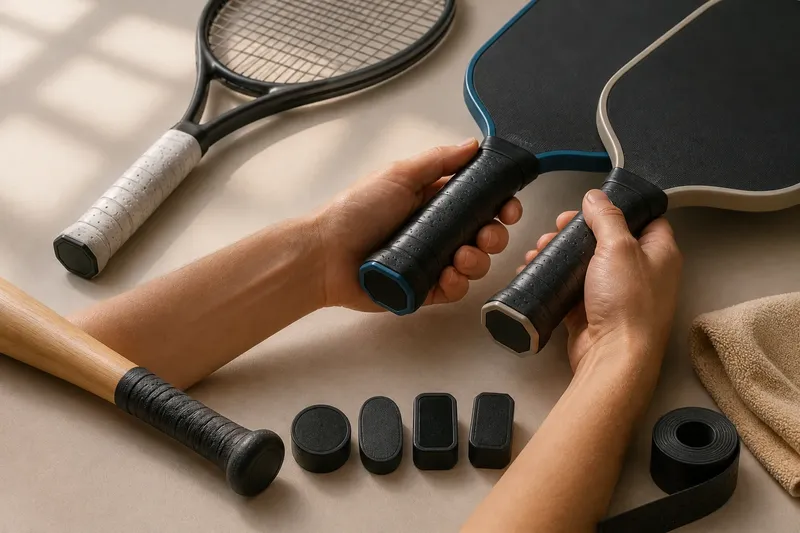
A racket handle can feel secure in the shop and awkward halfway through a session. Handle shape and grip feel influence how your hand settles, where pressure gathers, and whether you can adjust your hold without fuss. The useful choice is the one that suits your hand and the way you use the implement—not a shape that is supposedly best for everyone.
1. Start with how your hand settles
Close your hand around the handle as you would during play, without squeezing hard. Notice whether your fingers meet your palm comfortably, whether the handle sits naturally across your hand, and whether any edge presses into one spot. A handle that is too large may leave your fingers struggling to wrap around it; one that is too small may feel as if it disappears into your grip.
Try the same check with a relaxed hold and a firmer one. Some sports call for frequent grip changes, while others involve a steadier hold. In either case, comfort is about more than whether your fingers can close: your hand should be able to make the movements your activity requires.
Say you are choosing between two pickleball paddles. Imagine that one handle lets your fingers rest without crowding, while the other makes your knuckles feel compressed when you hold it naturally. That difference gives you a concrete reason to favor the more comfortable fit, even before considering how each paddle feels in motion.
2. Notice what the cross-section asks your hand to do
Handles may be round, oval, rectangular, or shaped with flatter faces and defined edges. A rounder profile can feel smooth and easy to reposition. Flatter faces may make the handle’s orientation easier to sense through the palm, which some players like when a particular face needs to line up with their grip. Neither profile is automatically more comfortable; hand size, preferred hold, and sport all matter.
Pay attention to pressure at the base of the fingers and along the thumb. A broad face can spread contact across a larger area, while a pronounced corner can be noticeable if it lands against a sensitive part of your hand. On the other hand, a shape with no clear orientation may feel less informative to someone who relies on edges to locate the implement.
Ask whether the shape feels settled at rest and during a small, natural grip adjustment. Avoid forcing your hand into a position simply because the handle’s geometry seems familiar.
3. Read the surface as part of the fit
A handle’s surface changes how it meets the skin. A smooth finish may allow easy repositioning, but it can feel less secure to a player whose hands become damp. A textured or tacky surface can add a clearer sense of contact; if it feels rough or grabs the skin, it may become distracting. Texture is a comfort preference as well as a handling feature.
Look at the grip material and its condition. On a tennis racket, an overgrip adds a layer over the underlying grip. A worn, compressed, or peeling layer can feel very different from a fresh one, so assess the surface you will actually hold. For a bat or paddle, examine the grip where your palm and fingers make contact, rather than judging it by appearance alone.
Surface preference can also change with the setting. Consider whether you usually play indoors or outdoors, and whether your hands tend to stay dry or become sweaty. These are clues for what to notice, not a reason to choose the most aggressive texture available.
4. Consider thickness, padding, and the room for adjustment
Grip thickness affects the space your hand has to close around. Added wrapping can increase that thickness, while cushioning can soften contact and make edges feel less pronounced. A thinner or firmer covering may preserve a more direct sense of the handle’s shape. The trade-off is personal: more padding may feel pleasant but obscure details that help you locate your grip.
If you are comparing wrapped handles, hold each with the same kind of relaxed grip. Notice whether your fingers can settle without strain and whether the thumb rests comfortably. Do not assume that adding layers will fix a poor fit; a thicker wrap changes the handle’s effective size and can alter its feel.
For a replacement grip or overgrip, follow the implement maker’s instructions for compatible products and fitting. If a covering becomes damaged, slippery, or uncomfortable, inspect it before the next session rather than trying to compensate with a tighter hold.
5. Compare handles in the movement your sport uses
A handle can feel fine while stationary yet become uncomfortable when you swing, turn, or change grip. If a safe opportunity is available, make a few easy, sport-appropriate movements with the implement. Notice whether the surface shifts under your hand, whether the edges remain comfortable, and whether you can make the adjustments you normally need.
Do not use a full-power swing or an unfamiliar movement just to judge a handle. The aim is to notice fit and contact, not to conduct a performance test. If the implement is shared or borrowed, ask before handling it and use it only as permitted.
Keep the comparison focused: one handle may feel more cushioned, another may make its orientation clearer, and a third may let your hand reposition more freely. Naming the specific difference makes the choice easier than relying on a vague impression such as “better grip.”
What should you look for in a comfortable handle?
How do you tell if a handle is too large?
Your fingers may struggle to wrap around it, or the hold may feel awkward even when relaxed. Pay attention to whether you can make the grip changes your activity calls for.
Does a textured handle always feel more secure?
No. Texture can make contact easier to sense, but a rough or overly sticky surface may irritate the skin or hinder repositioning. Choose a finish that feels comfortable in the conditions where you usually play.
Can an overgrip change how a racket handle feels?
Yes. It adds thickness and changes the surface your hand touches, so the handle may feel softer, tackier, or larger. Check that the finished grip still sits comfortably in your hand.
Should a handle’s shape match a particular grip style?
It can help if the profile supports the way you hold and adjust the implement, but there is no universal match. Choose by how your hand actually settles and moves.
6. Let comfort guide the final choice
Before deciding, compare the handle with your own hand rather than with someone else’s preference. Check the cross-section, surface, thickness, and padding, then notice what happens during a gentle movement relevant to your sport. A handle that feels comfortable without demanding extra pressure is a sensible candidate; so is one whose shape gives you useful orientation without pinching or distracting you.
Write down the feature that matters most to you, such as room for your fingers, a less abrasive surface, or a clearer sense of the handle’s angle. That short note can keep a shop comparison grounded in fit and comfort. The right handle shape is the one that lets your hand settle naturally and do its work without asking you to fight the grip.